
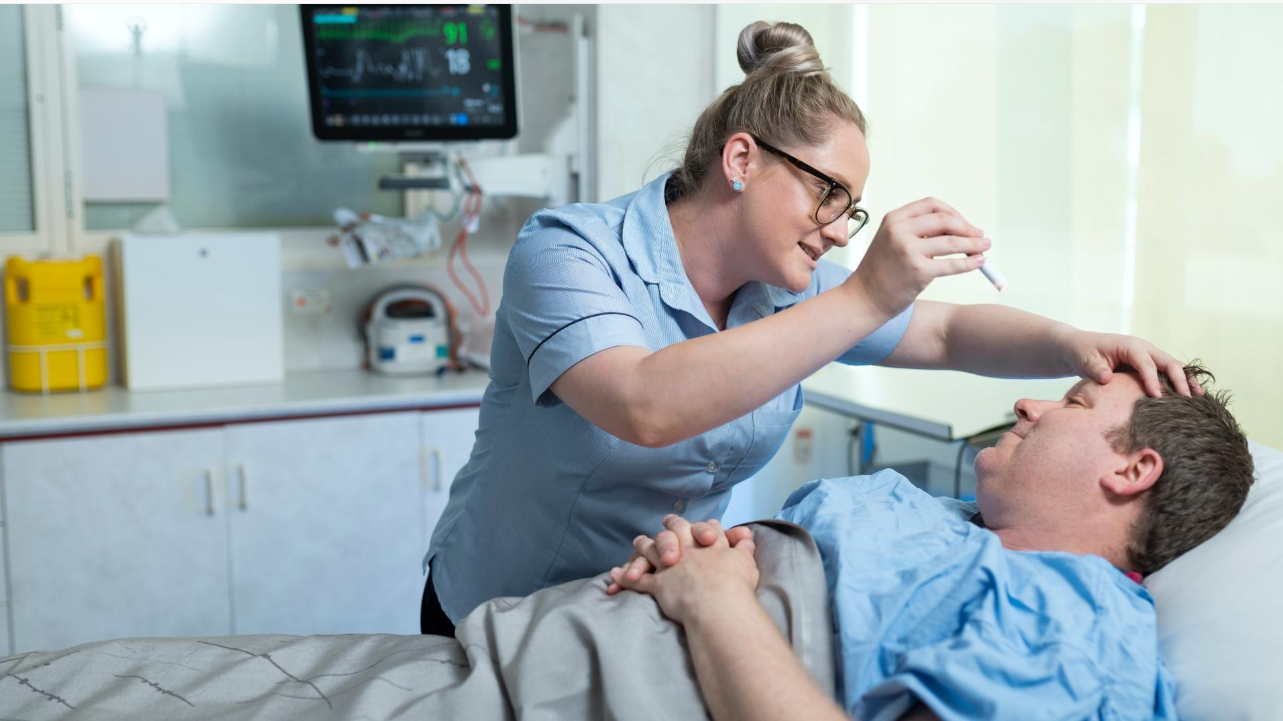
Neurological assessments are essential for recognising changes in a patient’s neurological condition. However, small assessment mistakes can lead to inaccurate observations or delayed recognition of deterioration.
Here are seven common neurological assessment mistakes nursing students should avoid, along with practical tips to improve assessment accuracy and patient safety.
7 Common Mistakes and How to Avoid Them
1. Not Establishing Baseline Observations
Mistake: Performing an assessment without reviewing the patient’s previous neurological findings.
Better approach: Establish and document baseline observations. Compare subsequent findings to identify changes.
2. Incorrectly Scoring the Glasgow Coma Scale (GCS)
Mistake: Guessing a GCS score or recording only the total score.
Better approach: Assess and document eye, verbal and motor responses separately (E, V and M). Record components that cannot be tested appropriately.
3. Overlooking Pupil Changes
Mistake: Checking pupil size without assessing reactivity or comparing both pupils.
Better approach: Assess pupil size, symmetry and response to light. Recognise and escalate new abnormalities.
4. Not Comparing Limb Strength
Mistake: Assessing limb movement without comparing the left and right sides.
Better approach: Assess and compare bilateral limb strength and movement. Report new weakness or asymmetry promptly.
5. Incomplete Documentation
Mistake: Recording vague descriptions such as “neurologically stable” without specific findings.
Better approach: Document objective observations, relevant scores, assessment times and changes from baseline.
6. Missing Subtle Neurological Changes
Mistake: Focusing only on major changes in consciousness while overlooking new confusion or altered behaviour.
Better approach: Observe trends and investigate changes from the patient’s usual neurological status.
7. Delaying Escalation
Mistake: Waiting for further deterioration before reporting new neurological abnormalities.
Better approach: Promptly inform the supervising registered nurse or appropriate clinical team and follow local escalation protocols.
Key Takeaway
Accurate neurological assessments require consistency, attention to detail, and early recognition of changes. Always compare findings with baseline observations, document assessments clearly, and promptly escalate new or worsening neurological abnormalities.
Want to learn the complete assessment process? Explore our Neurological Assessment Guide for a structured, step-by-step learning resource.